What She Carried Out of It
A woman bakes a cake from the ruins of her country, inside the most pleasant show on television. I've been thinking about what that means ever since.
A woman bakes a cake from the ruins of her country, inside the most pleasant show on television. I've been thinking about what that means ever since.
I was watching The Great British Bake Off the other night—half paying attention, the way you do with a show that runs on pleasantness; my kind of cooking show. The tent, the rolling countryside, the pastel aprons, the judges offering criticism so gently it almost sounds like encouragement. The whole production is engineered to feel safe. That’s the thing about the show—it’s one of the last places on television where everyone is genuinely kind to each other, where competition exists inside a container of warmth and British good manners that never quite breaks, no matter what happens to anyone’s soufflé. You watch it the way you sit in a warm bath. Nothing is going to go wrong. Nothing is at stake except cake.
And then Nataliia made me set the dish I was washing down.
The first Ukrainian contestant the show has ever had. She spoke gently, moved through the tent with a careful steadiness, and baked with the concentration of someone for whom the act of making something beautiful was not casual. Her family had come to the UK after the war started. She was shaping a pastry with flavors from home—building it from memory, in that tent, surrounded by all that kindness—and something I’d been thinking about for a long time clicked into focus.
Because the tent wasn’t built for what she was carrying. It was built for Victoria sponges and friendly competition and the lovely pressure of a ticking clock. It was built for people whose stakes are a handshake from Paul Hollywood. Nataliia was standing in the same space, using the same ovens, following the same format, but the weight behind her hands was different. She was baking from a country that was still being shelled. The tent couldn’t hold that. It held her anyway.
Displacement does a strange thing to culture. It sharpens it. People who are forced to leave carry what they can—language, recipes, songs, the way a particular dough is supposed to feel between your fingers—and the distance from the original source turns those things from habit into evidence. Proof that the place was real. That they came from it. That it mattered enough to hold onto even when holding onto anything at all was a kind of luxury.
I’ve seen this my entire career. The way a Peruvian grandmother in Miami makes aji de gallina with a precision that would embarrass a chef in Lima, because for her the dish is doing work that has nothing to do with dinner. The way a Syrian baker in Berlin shapes his bread slowly, as if rushing it would betray something. The urgency is quiet, but it’s there. The food becomes a container for everything that can’t be said in the new language yet.
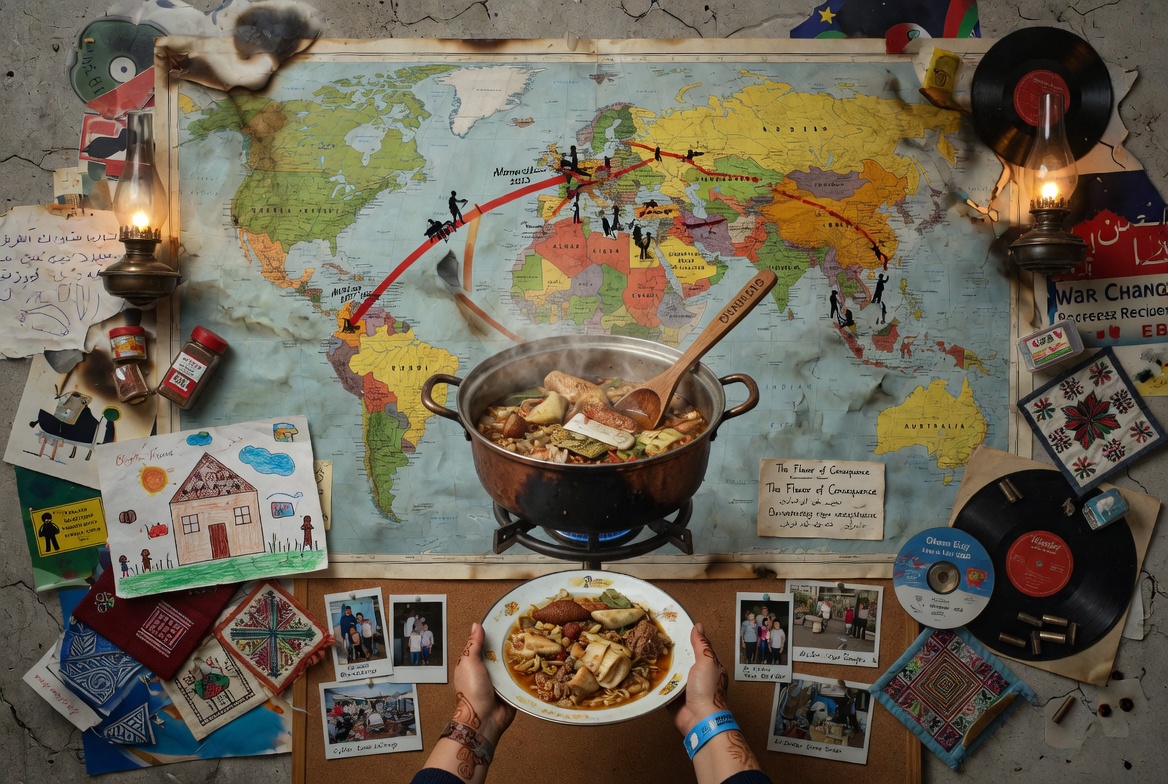
Here’s the thing I keep returning to, and it’s uncomfortable. Some of the most vital cultural movement in human history traveled on the back of catastrophe. War scatters people, and people carry their kitchens. Conquest opens trade routes that outlive the empires that built them. The collapse of one civilization seeds the next. This is ugly arithmetic, but it’s accurate. The spice routes carried conquest alongside cinnamon. Flavors we now call native—ingredients entire nations claim as their own—arrived through someone else’s violence. The food your grandmother made, the dish you think of as the purest expression of where you come from, came together through crossings that were rarely chosen freely.
Jazz is the clearest American example. An art form forged under the weight of oppression that became the most influential musical language of the twentieth century. The pressure was the point. The constraint shaped the invention. The suffering produced something that outlasted every institution that caused it. This is what culture does under duress—it compresses, and the compression creates something dense enough to survive the journey.
I want to be precise about this, because it’s easy to slide into the wrong conclusion. Recognizing that expansion has historically traveled alongside suffering is a different thing from justifying the suffering. One is observation. The other is obscenity. What it reveals is how relentless the impulse is—the impulse to make something, to carry something forward, to cook and sing and shape and build even when the ground underneath you is actively disappearing. Life keeps growing through ruin because the alternative is just ruin, and people tend to reject that option with a stubbornness that borders on biological.
Nataliia, in that tent, was baking a landscape. A country still being shelled, translated into flour and sugar and the specific fragrance of whatever spice or fruit carried her back to a kitchen that may or may not still be standing. She was precise about it. Measured. The way someone is when the thing they’re making has to hold more weight than a cake should have to hold.
The judges tasted it and said it was extraordinary. They were talking about the bake. But what they were tasting was something older than the recipe—the particular intensity that shows up when a person is making food from a place they can’t go back to. I’ve tasted that intensity in refugee kitchens and exile restaurants and the apartments of people who cook their mother’s recipes in cities their mothers will never visit. It has a quality that technical skill alone can’t produce. It comes from context, from need, from the gap between where the food comes from and where the food is being made.
The question that stays with me—the one I’ve been writing around for years now—is whether we can create that kind of cultural exchange without the catastrophe. Whether the cross-pollination that produces new cuisines and new art forms and new ways of understanding flavor has to begin with someone losing their home. Whether there’s a version of contact between worlds that starts with curiosity instead of rupture.
I’m not sure there is, historically. Almost every cuisine I admire is the product of collision—voluntary or otherwise. Almost every dish I love carries the residue of someone’s displacement. That’s the inheritance the food holds, whether the person eating it knows it or not.
But I know what I saw in that tent. A woman making a cake from the ruins of her country, inside a space built for gentleness, surrounded by people who were kind to her in the specific way the British are kind—warmly, politely, without quite knowing what to do with the thing she was carrying. She was steady, careful. The cake was extraordinary. And the fact that it existed at all—that she could shape something that beautiful from that much loss, in a place that pleasant, under lights that bright—was, in its own quiet way, an answer to a question I’m still learning how to ask.