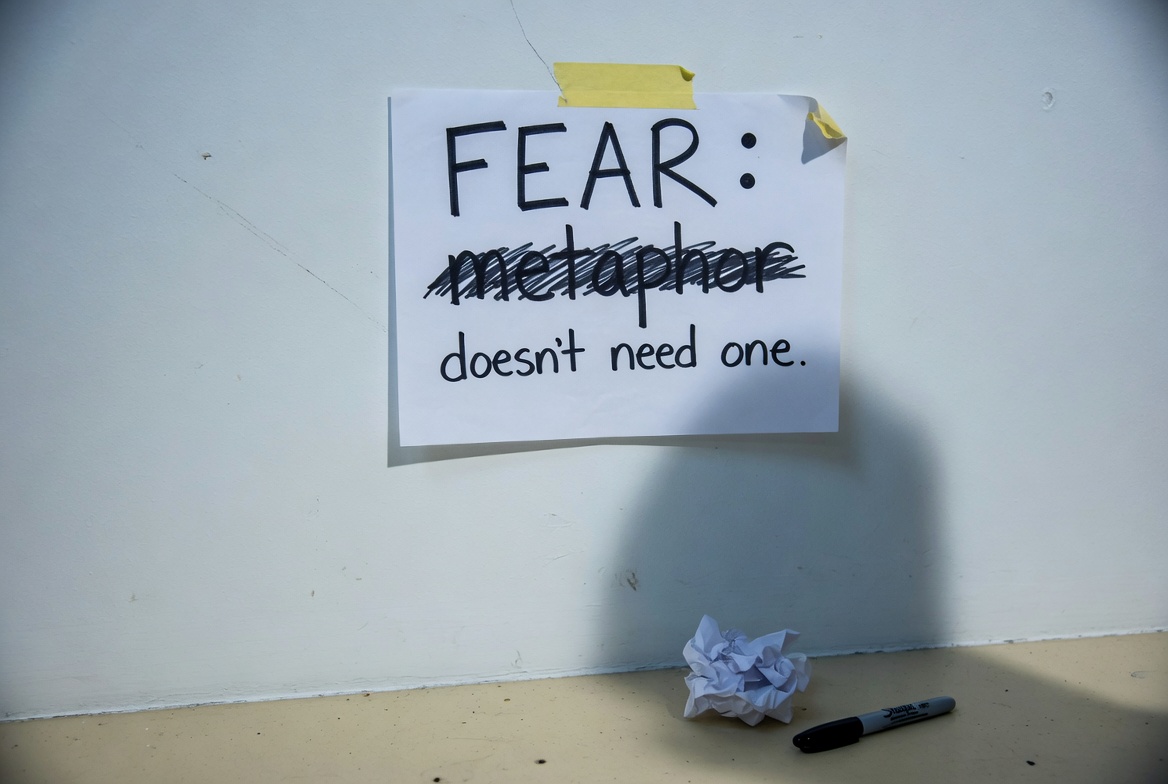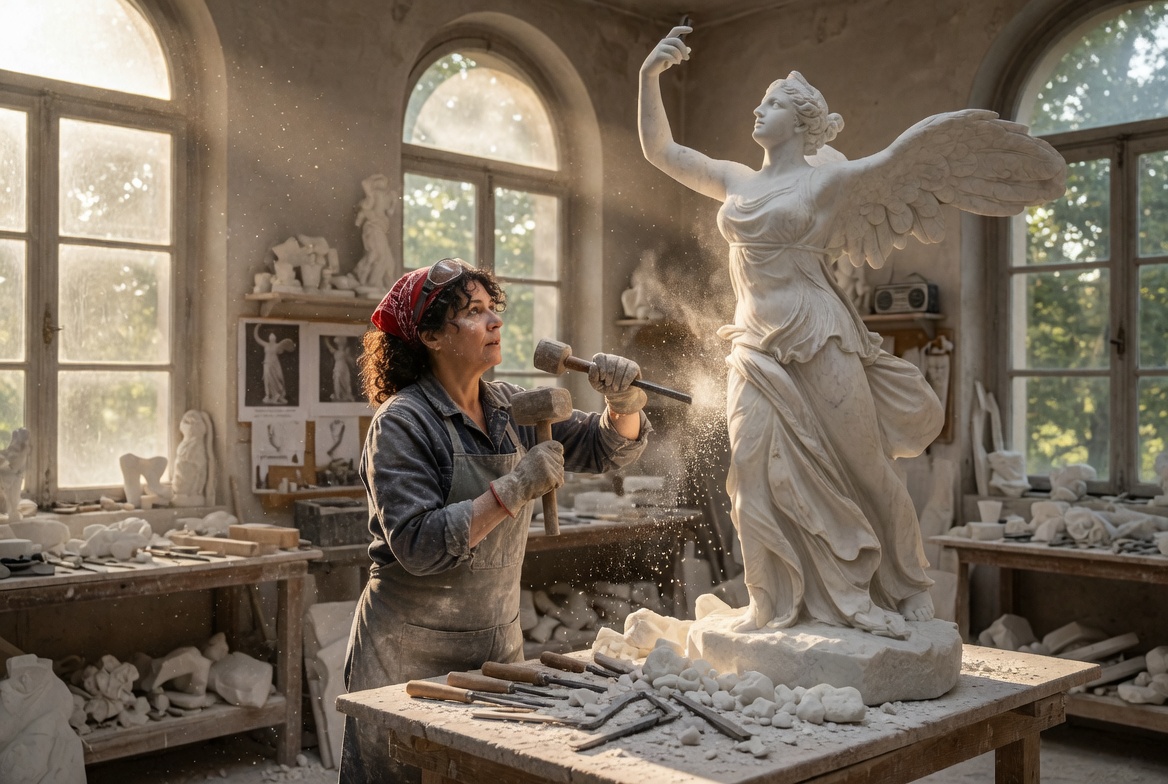
The oldest known act of human creativity isn't a painting. It's a handprint — pigment blown around an outstretched hand onto a cave wall, somewhere between 40,000 and 250,000 years ago depending on the site. Someone crouched in flickering light, mixed ochre or charcoal with water, and exhaled. Left a mark that said something — what exactly, we'll never know. But the impulse behind it is legible across every century that followed.
That same impulse is currently running on a server farm somewhere, generating neon fractals.
The first hack
Around 250,000 years ago, something shifted in the architecture of the human brain. Not a single mutation — more like a network coming online. Scientists call it cognitive fluidity: the point at which previously isolated brain functions — toolmaking, social reasoning, spatial memory, emotional processing — stopped operating in separate compartments and started talking to each other.
The result was symbolic thought. A mark stopped being just a mark. It became a stand-in for something else — a trail, a warning, a name, a god. The gap between the physical world and the mental representation of it collapsed, and in that collapse, culture became possible.
This is the original code. Everything since — cave paintings, written language, the printing press, the internet, generative AI — is essentially the same operation running on progressively faster hardware. Take existing symbols. Recombine them in new configurations. Test whether the result carries meaning. Repeat.
The upgrades
The timeline is worth holding in your head because each jump follows the same logic.
Forty thousand years ago, the cave walls at Lascaux and Chauvet weren't isolated images — they were compositions. Narratives. Shared memory externalized onto stone so it could outlive the people who made it. The first attempt at a hard drive.
Five thousand years ago, writing formalized that externalization. Ideas could now travel across distances and generations without a human body carrying them. Wisdom became transferable in ways that didn't depend on proximity or memory.
The printing press democratized what writing made possible — not a new invention so much as a scaling mechanism. More people, more ideas, more combinations.
Each iteration follows the pattern: externalize a cognitive function, make it distributable, watch what gets unlocked when the previous constraint disappears.
What the genetics actually show
Here's where it gets interesting. Modern geneticists have identified coordinated networks — thousands of genes operating together — that predispose humans toward curiosity, emotional regulation, and imaginative recombination. These networks appear to have emerged around 100,000 years ago. They're largely absent in Neanderthals.
Neanderthals weren't uncreative by any reasonable standard — there's evidence of pigment use, personal ornamentation, some symbolic behavior. But they never produced anything like the sustained, complex symbolic systems that Homo sapiens built. No Lascaux. No mythology. No accumulated, transmissible culture that compounds across generations.
The difference wasn't raw intelligence. It was the capacity for a specific kind of combinatorial thinking — the ability to take things from completely different domains, hold them in relation to each other, and generate something that didn't exist in either domain alone.
That capacity is what got wired in. It's what every healthy human brain carries. And it's what we've now, inadvertently, taught machines to approximate.
What AI is actually doing
A diffusion model trained on five billion captioned images isn't doing something categorically different from what a human brain does when it generates a novel image. It's learned the statistical relationships between concepts — what "Van Gogh" tends to look like in proximity to what "cat" tends to look like — and when prompted, it finds the intersection. Recombination at scale.
This isn't a diminishment of what AI does. It's a clarification of what creativity actually is.
We've romanticized the creative act as something that arrives from elsewhere — inspiration, the muse, divine spark. But the cognitive science suggests something more mechanical and, honestly, more interesting: creativity is pattern recognition followed by pattern violation followed by pattern synthesis. You have to know the rules well enough to break them in ways that still make sense to someone else.
AI has ingested enough patterns to approximate the first and third parts of that sequence reasonably well. The second part — knowing which rules to break, and why, and for whom — is still the domain of whoever is holding the intent.
The loop that keeps opening
History keeps making the same argument: every time we've outsourced a cognitive task, we haven't diminished human creativity. We've displaced it upward.
Writing didn't kill memory culture — it freed cognitive bandwidth for philosophy and narrative complexity that oral tradition couldn't sustain. Photography didn't make painting obsolete — it liberated painting from representation, which is how you get Cézanne and then Picasso and then abstract expressionism. The calculator didn't make mathematicians irrelevant — it offloaded arithmetic so mathematicians could work on harder problems.
The pattern is consistent enough to be a rule: externalize a function, watch what emerges in the space it leaves behind.
If the pattern holds — and there's no obvious reason it won't — AI absorbing the generative, combinatorial labor of content production will free human attention for the part that has always mattered more anyway: deciding what the output is for. What it means. Whether it's true. Whether it's worth making at all.
The part that doesn't automate
The Neanderthal versus Homo sapiens distinction is useful here, not as flattery but as functional description. A Neanderthal could imagine a spear. A Homo sapiens imagined the hunt, the feast, the story told afterward, the legend that kept the tribe coherent through the next winter. The object versus the narrative around the object. The tool versus the meaning system that gives the tool its value.
AI generates options. Humans decide which options matter and why. The curator has always been as essential as the generator — we just didn't need to articulate that when the generator was also human and the curation happened unconsciously inside the same skull.
Now the generator is external. The curation is exposed as its own distinct act. And it turns out that's the harder, more irreplaceable part of the two.
The handprint, again
The person who blew ochre around their hand in a prehistoric cave wasn't performing art in any sense we'd recognize. They were doing something more fundamental — asserting presence, encoding meaning, leaving a signal for whoever came after.
The impulse behind that act is the same impulse behind every novel, every algorithm, every half-formed idea you've written in the margin of something. It predates civilization. It's in the architecture.
AI running that same code on silicon hardware isn't a rupture in the story. It's the latest line in a document that's been accumulating for a quarter of a million years.
The question worth asking isn't whether the machine can create. It's what you do with the time it buys you.
Curated essays, interviews, and creative work—explore thoughtful writing and media for a more considered life.
![[headshot] image of satisfied student using a laptop](https://cdn.prod.website-files.com/69c46a43577166047b79ace8/69d1783e77f41302a3013235_4EE565A1-7A53-4901-862E-A7848741B5EF.JPG)