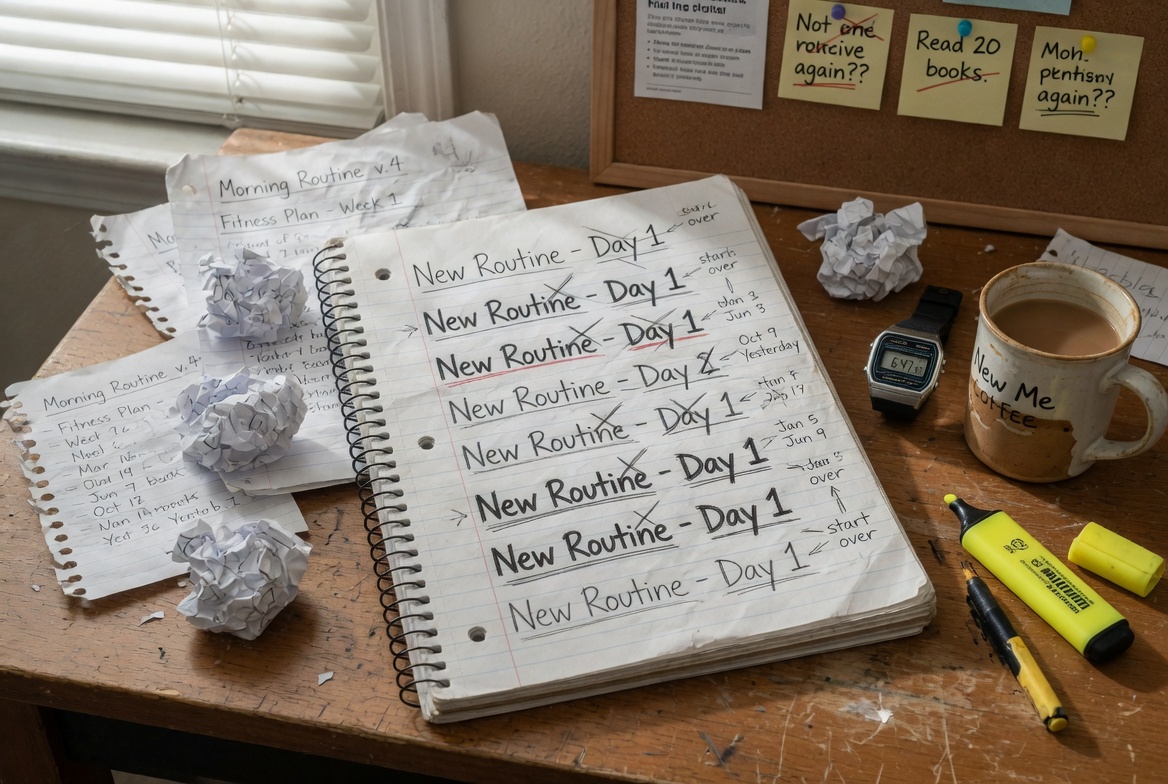
Most people blame willpower.
Why You Keep Starting Over
Most people blame willpower
Most people blame willpower
There's a version of this you've done before. The notebook. The alarm set for a time you've never actually been awake. The announcement to someone who didn't ask. And then, at some point — you're not even sure when — it quietly stops. Not with drama. Just stops.
Most people blame willpower. It's a clean explanation and almost always wrong.
The internal argument you're not aware of
The brain doesn't sabotage you randomly. It sabotages you specifically — around the things that would actually change something. Somewhere in the architecture, there's a belief that the thing you want comes with a cost you haven't consciously agreed to pay. Success means becoming someone your people resent. Money means losing the version of yourself that doesn't have it. The goal and the fear are running in the same loop, and the loop doesn't resolve — it just drains you.
You can map this if you want to. Write down what you actually expect to gain. Then ask what it costs. Not in time or money — in identity. That's usually where the real argument is.
Worry that looks like preparation
There's a particular kind of exhaustion that doesn't come from doing things. It comes from almost doing them — running through every scenario, every possible failure, every version of yourself that doesn't make it. It's thorough. It's also completely paralyzing.
The strange thing is it doesn't feel like fear. It feels like diligence. Like you're being responsible by thinking it through one more time. You're not. You're burning through cognitive fuel on a simulation that never ends, and then wondering why you can't move.
Vague intentions are not goals
"Get my life together" is not a goal. It's a mood. The brain needs a coordinate, not a feeling. Without specificity — a time, a location, a measurable outcome — there's nothing to orient toward. Hesitation fills the space.
The fix isn't motivation. It's precision. Not I want to exercise more, but I'm doing twenty minutes, Monday and Wednesday, at six, in the living room. The specificity isn't about discipline. It's about giving the brain somewhere to actually go.
Open loops
Every unfinished thing you own is still running in the background. The unanswered email. The half-read book. The project you technically started. They don't disappear when you ignore them — they idle. Quietly, persistently, they eat bandwidth you were planning to use for something else.
This is why you can sleep eight hours and still feel like you haven't. You're not tired from what you did. You're tired from everything you haven't finished.
The discomfort isn't failure — it's the unfamiliar
Here's the part nobody names clearly: sometimes the fear isn't about failing. It's about succeeding into a life that doesn't look like the one you already know how to navigate. What if you get there and the feeling doesn't match the expectation? What if everything changes and the person on the other side doesn't quite recognize themselves?
That's not weakness. That's a very old, very rational response to the unknown. The brain treats unfamiliar good and unfamiliar bad as the same category: uncertain. And uncertain is almost always flagged as dangerous before it's flagged as opportunity.
The way through isn't inspiration. It's small, repeated exposure — until the new pattern starts to feel like yours.
Five things. None of them laziness. All of them worth knowing.
Curated essays, interviews, and creative work—explore thoughtful writing and media for a more considered life.
![[headshot] image of satisfied student using a laptop](https://cdn.prod.website-files.com/69c46a43577166047b79ace8/69d1783e77f41302a3013235_4EE565A1-7A53-4901-862E-A7848741B5EF.JPG)