01 / Cocktails, craft & origins
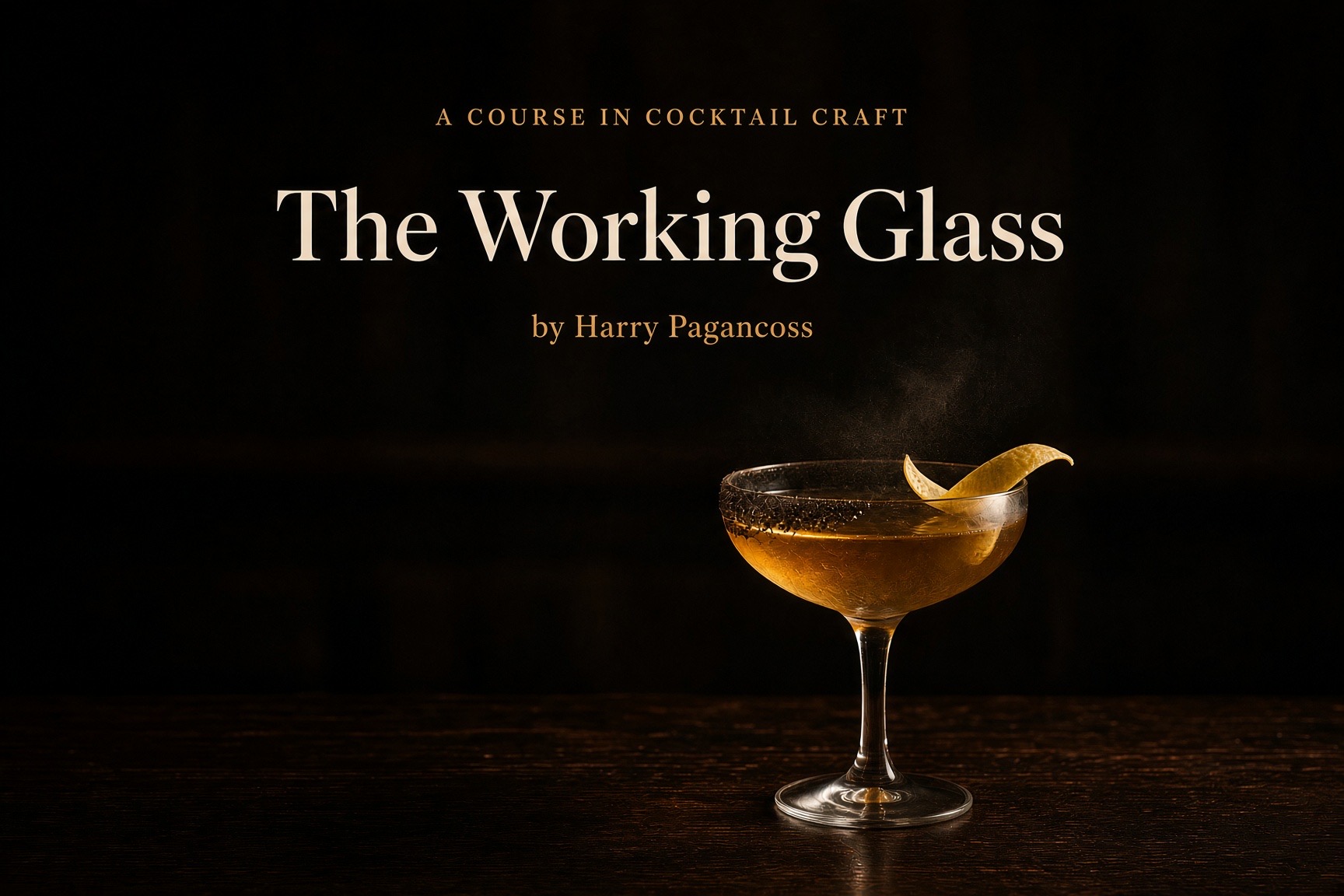
The Working Glass
Explore the origins of spirits, the balance of a cocktail, and the ingredients you can make yourself. Follow the lessons from the first taste to the finished drink, then experiment at the interactive Bench.
- Six modules
- 24 lessons
- Interactive Bench
The Working Glass · By Harry Pagancoss
A course in cocktail craft.
You learn a cocktail the way a cook learns a sauce. Taste first. Then the ratios, which are the physics. Then the bottle: how it is made, how to buy it, where the plant grew, and what a culture actually wants in the glass. You make the sugar, the acid, and the bitters. You learn the ice, the glass, and the perfume above the sip. Twenty-four lessons. You leave able to build a drink from an idea and say why it worked.
6 modules · 25 lessons
01Foundations4 lessons
Taste, the jobs inside a glass, the ratios, and the curves that decide whether a drink is finished.
- How a drink is tasted. The nose, the first second, the middle, and the finish. The palate is the tool. The shaker comes later.
- The parts of a cocktail. Six jobs. Most good drinks hire only three or four, and you learn to name which one failed.
- Ratios. The physics. Learn the sour, the old fashioned, the martini, the negroni, and the highball, then break one number on purpose.
- The curves. Balance is a short ridge, not a point. Sweet, acid, water, and bitter each have a shape you can feel.
02The bottle4 lessons
How spirits are made, what each family is for, how to buy one, and the bottles that are not the star.
- How spirits are made. Ferment, distill, cut, proof. Oak only if the style actually uses it.
- A map of the bottle. What whiskey, gin, rum, agave, brandy, and vodka are for when you are making a drink. Not a catalog.
- How to buy a bottle. What the label can tell you, and the three words you taste for before you pay for a story.
- Vermouth, amaro, and the rest. The bottles that share the glass with the spirit, and the ones that go bad if you forget the fridge.
03Origins4 lessons
Why people have kept this drink, the plant, the place, and the bottles that disappeared.
- Why alcohol. Older than writing. Why the first glass feels good, and why the course stays on that side of the dose.
- Materia prima. The plant comes first. Grain, grape, cane, agave, and the ones a map that starts in Scotland leaves out.
- What fell out of the glass. Spirits that died, were banned, or were renamed into something milder.
- The taste of a place. Why one table wants amaro, another a highball, another smoke. People drink what the weather, the meal, and the tax man made normal.
04The pantry3 lessons
Syrups, cordials, acid, shrubs, and bitters you make instead of assuming.
- Syrups, cordials, and oleo. The sugar most recipes quietly assume you already understand.
- Acid. Lemon and lime first. Then what to do when the fruit will not cooperate.
- Bitters, and how to make them. Seasoning in dashes. A jar, a high-proof spirit, and a week of patience.
05The craft6 lessons
Ice, the hands, when a drink wants to be clear, what belongs on it, and the glass it is served in.
- Ice and dilution. Water is an ingredient. Ice is how you add it without losing the cold.
- Hands. Stir, shake, build, strain. The reasons, not the performance.
- Clarification. When a drink wants to be clear, and how milk and agar get it there.
- Jewels. A half rim of black salt and smoked paprika. A foam from egg, aquafaba, or lecithin. A brandy crusta. If it doesn’t change the smell or the sip, it doesn’t go on.
- Dressing. The glass is the serve. Which shape, what quality is worth paying for, and why a gin and tonic wants a large globe.
- Perfume. The smell before the sip. Expressed oil, a fine mist of bitters or amaro, and smoke. Fire only when it lifts the drink.
06The drink4 lessons
What “great” means, the templates worth knowing, and how to build from an idea.
- What makes a great cocktail. Balance is the floor. It is not the whole room.
- Templates you can cook from. Old fashioned, martini, Manhattan, daiquiri, whiskey sour, negroni, highball, Tommy’s. Formulas, not scripture.
- A wider glass. The drinks a table actually orders. Spritz, dessert, the holiday cup, hot drinks, and the ones that left.
- Building a drink from an idea. Change one thing at a time, and write the spec before the night lies to you.